













From scenic trails to cross-state greenways, here are some of Florida's must-see biking areas.
Boasting thousands of miles of off-road trails, paved pathways and scenic country roads, Florida's cycling options are almost endless. That said, there are a few must-rides that all cyclists - from beginners to race-ready veterans - should make part of their Sunshine State itinerary.
Shaded miles and Civil War whispers
Beginning in the northeast corner of the state, the Jacksonville-Baldwin Trail offers an excellent introduction to Florida cycling, blending urban convenience with Old Florida scenery. Start peddling the 14.5-mile paved trail at the Imeson Road Trailhead, just a few miles west of downtown Jacksonville. The pathway meanders through pine flatwoods, wetlands and hardwood canopies that provide both shade and seclusion. In addition to the flora and fauna - hawks, wild turkey and deer, to name a few - the Jacksonville-Baldwin trail also traverses McGirts Creek, site of a Confederate Civil War camp.
Prairie views, wild encounters
Just an hour or two to the southwest, the Gainesville-Hawthorne Trail offers more scenic paved cycling. This well-traveled trail winds from the city of Gainesville through Paynes Prarie Preserve State Park and into the Lochloosa Wildlife Management Area, ending on the outskirts of Hawthorne. The trail's hills provide challenging climbs and exhilarating downhills, as well as panoramic views of Paynes Prairie, where cyclists should keep an eye out for wild horses, bison and sandhill cranes. A spur trail near the Gainesville trailhead leads to the wildflower-covered Alachua sink, home to a mind-boggling number of alligators.
Long miles through old Florida
Florida's longest continuous rail-trail begins less than an hour south near the small town of Dunnellon. The Withlacoochee State Trail is as fun to cycle as it is to pronounce, running 46 miles south to Trilby. While "Withlacooche" translates to "crooked river," the trail itself is relatively straight, passing through the pristine, 150,000-acre state forest by the same name. Running past ranches, small towns and wildlife-rich preserves, the pathway also serves as a gateway to other recreational pursuits. The fat tire crowd will want to challenge the 50-plus miles of the Croom Off-Road Trail, while paddlers should check out the 83-mile canoe trail.
Small towns and spring-fed escapes
Continuing west, natural springs begin to outnumber cities and cyclists eventually reach the Nature Coast Trail. One of the state's most beautiful rails-to-trails projects, the 32-mile paved pathway connects the rural communities of Chiefland, Trenton, Fanning Springs, Old Town and Cross City. A "T" shape, the Nature Coast Trail can be ridden in several configurations. Starting at the old train depot in Cross City, riders can peddle east toward Old Town where they'll cross the lazy Suwannee River on a historic train trestle. Cyclists may continue east to Trenton or head south. The southern route leads directly past Fanning Springs State Park, the perfect place to take a break and cool off swimming or snorkeling the crystal-clear springs.
Coastal cruising with city charm
Just to the south, visitors will find one of Florida's best urban trails. The Pinellas Trail runs 47 miles, traversing natural areas, charming downtowns and urban centers. From the south, the trail begins just outside downtown St. Petersburg, the cultural center of Florida's West Coast. Winding north through neighborhoods and across intracoastal waterways, riders reach the quaint Scottish town of Dunedin. A scenic trail leads to Honeymoon Island State Park, where cyclists can catch a ferry to the award-winning beaches of Caladesi Island. The trail ends in Tarpon Springs, where tired road warriors may reward themselves with an authentic Greek meal and a stroll around the historic sponge docks.
Epic coast-to-coast adventure
For the serious cyclists, nothing can top the challenge of biking coast-to-coast on one of Florida's cross-state trails. The Marjorie Harris Carr Cross Florida Greenway is among the most beautiful of these trails, traversing 110 miles of swamps, rolling hills and dense forests. Built largely along the failed Cross Florida Barge Canal, nature and history come in equal doses on this trail, which runs from Inglis east to the St. John's River. Innumerable side trails offer off-road adventure and exploration, and abundant wildlife habitat affords the chance to see Florida black bears, deer, alligators and even manatees.
Flat, fast and far from it all
If you’re looking for a remote, rural spin that’s an escape from the crowds, the 29-mile, paved General James A. Van Fleet State Trail can’t be beat.
Sited west of Orlando, the Van Fleet Trail rolls straight and flat through the Green Swamp, one of Florida’s most important watersheds and the source of four major rivers. Keep your eyes peeled for deer, otters, wild turkeys, alligators, herons and sandhill cranes on the path as it passes by tangled cypress swamps, lush hardwood hammocks, pine forests and cattle ranches.
The trail has mile markers, making it easy to track your distance, as well as numerous benches and areas to rest or grab a snack. Four trailheads provide easy access to different sections of the Van Fleet, with the northernmost point located at Mabel in Sumter County, and Polk County’s Polk City marking the terminus to the south.
Off the Grid
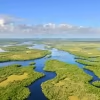
At Bear Island, you’re miles away from it all. Nestled in the westernmost section of the 729,000-acre Big Cypress National Preserve in the far reaches of southwest Florida, Bear Island is naturally home to an astonishing amount of wildlife, including the endangered Florida panther. Arguably the best place for riding in the Everglades, biking at Bear Island is more enjoyable in the winter months, when the insects have decreased.
Instead of a marked bike path, you’ll be riding on off-road vehicle trails, so be prepared for areas that may be difficult to negotiate. For the most part, the ride is on hard-packed gravel road, so mountain bikes or hybrid bikes with wide tires are recommended. Three primitive campgrounds are available, and one is accessible by car) For the two more primitive sites, be sure to call ahead as you’ll need a permit to camp at these off-road locations. Bear Island is very remote, so you’ll need to bring along at least a basic first aid kit, sunscreen and plenty of water, and be sure to tell friends or family about your plans.
On your way to Bear Island, stop by the Oasis Visitor Center at 52105 Tamiami Trail East or the Nathaniel P Reed Visitor Center at 33000 Tamiami Trail East Tamiami Trail for permits, maps and directions.
Ride smart, ride happy
Happy bikers are bikers who are prepared. Wear clothing that’s appropriate for the weather, always wear a helmet, and pack a snack or lunch as well as plenty of water, sunscreen and insect repellent. On any outing, tell a friend or family member your plans, and properly secure your vehicle at the trailhead.


