







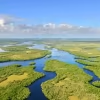
MARCO ISLAND
Where
Marco Island is home to two public beaches, South Marco Beach and Tigertail Beach. The latter is located at 480 Hernando Dr., Marco Island, FL 34145.
Vibe
Secret two-in-one beach with a mild and wild side. Tigertail Beach has a split personality, encompassing two distinct areas, one by a tranquil lagoon with amenities that include restrooms and a bird-watching tower that promises soaring views. Reaching the second area involves an adventure: Wade across the lagoon’s shallow waters to discover three miles of untamed beaches where nature is at her resplendent best.
See, feel
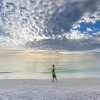
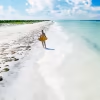
Tigertail Beach curves into the Gulf waters, with a saltwater lagoon on one side. To get to the beach, balance your belongings above you as you ford the lagoon. If you’re not sure where to go, follow someone else. Be prepared for the mucky bottom—you may want beach shoes-- and for the armies of fiddler crabs that will scurry out of your path at low tide. Even at high-tide, the lagoon’s water won’t be more than waist-deep. The reward is a glorious, white sand beach bordered by blue-green waters, staged against a landscape of dunes. Here, beachgoers scoop up colorful shells along the shoreline; ospreys glide on the laminar salt air; and dolphins are frequent visitors. If you’re not up for the escapade across the lagoon, you can walk around it to the south, but it will take longer to reach the beach, perhaps 20 minutes. While the water is usually calm, winds, tides and offshore systems can occasionally make conditions rough.
On or near the beach
Swimming, sunning, and birdwatching are popular here, and the sunsets are epic. You can bring home more than a tan, because Tigertail is a prime spot for shelling, with abundant Fighting Conchs, Lightning Whelks, and Calico Scallops. Make sure to peer into the gin-clear tidal pools along the shore; they’re brimming with sea stars, sand dollars and other tiny sea creatures.
Accessibility
Tigertail Beach is ADA compliant.
Facilities
Tigertail Beach currently offers a picnic area, a playground, and restrooms. Pack in whatever supplies you need, including food, drink, sunscreen and insect repellent. Brochures and
maps are available. Due to damage from Hurricane Ian, the concessions, food/beverage service; jet ski rental; paddleboard rental; watersport/beach gear rental; beach wheelchair; and guided tours are all closed or unavailable until further notice. Here’s where you can check the park’s current status, or call 239-252-4000.
Lifeguards
There are no lifeguards; swim at your own risk.
Parking
Tigertail Beach offers 210 parking spaces, and includes ADA parking. Here’s more information about parking.
FREQUENTLY ASKED QUESTIONS ABOUT TIGERTAIL BEACH
Q. Where is Tigertail Beach?
A. At 480 Hernando Drive on Marco Island, in Collier County on Florida's southwest coast. It is a 42-acre Collier County park, open year-round from sunrise to sunset. See the county's Tigertail Beach Park page.
Q. Why does the beach look like a lagoon?
A. What you see from the parking lot is a shallow tidal lagoon, not the open Gulf. The wide stretch of Gulf sand that people picture is on the far side of it, a long sand spit known as Sand Dollar Island. The county describes the park as a manicured shoreline, and just across the lagoon, a wild, untamed space.
So, if you want open water and surf, you have two options: wade across the lagoon, or walk around its north end. The crossing is shallow but the depth changes with the tide, so check it before you commit and carry anything you mind getting wet above the waterline. The walk around takes a while but keeps you dry.
Q. What is Sand Dollar Island?
A. The official designation for the island is the Big Marco Pass Critical Wildlife Area, a 456-acre site designated by the Florida Fish and Wildlife Conservation Commission. It’s locally known as Sand Dollar Island and is an important shorebird site.
Least terns, black skimmers and Wilson's plovers nest there, along with wintering shorebirds. Nesting areas may be posted closed from March 1 through Aug. 31, and the submerged mudflats are posted closed year-round to protect feeding birds. See the state's page on the area.
Where signs mark a posted closure, state rule prohibits dogs, vehicles, vessels and fishing inside it. Stay out of roped areas, do not fly kites near nesting birds, and give the flocks room. The state's rule of thumb is 500 feet, and a simpler one: if the birds are agitated, you are too close.
Q. Is it good for birdwatching?
A. It is one of the best all-around birding spots in southwest Florida, with a species list of more than 175.
The lagoon draws Wilson's, piping and snowy plovers, least terns, roseate spoonbills, red knots, reddish egrets and magnificent frigatebirds. Spring and fall migration turn it into a genuine hotspot, with more than 20 warbler species recorded. There is an accessible wildlife viewing tower with scopes and identification guides. See the Florida Birding Trail entry.
Q. What is open at the park right now?
A. The concessions, the food and beverage service, the jet ski rental, the paddleboard rental, the beach gear rental and the guided tours are all listed as closed until further notice due to hurricane damage.
Still going: restrooms, picnic areas, the playground, the viewing tower, self-guided tours and the parking lot. Bring your own water, food, shade and chairs. There is nothing to buy and nothing to rent on site.
Q. How does parking work?
A. There is a fee unless you hold a Collier County resident beach parking permit. Pay by phone through the QR code or by text at the lot; the park takes Visa and MasterCard.
Non-residents cannot buy a permit. Current rates and permit rules are on the county's beach parking page. In season, arriving before 10 a.m. is the difference between parking and circling.
Q. Are there lifeguards?
A. No. Tigertail is unguarded, and the county does not publish a live warning flag status for it, since flag reporting covers the lifeguarded beaches only.
For water quality, the Florida Department of Health samples Tigertail as part of its Healthy Beaches program. For day-of park conditions, call Collier County Parks and Recreation at 239-252-4000. Swim with the usual caution, watch the tide in the lagoon, and keep an eye on children near the pass.
Q. Can I bring my dog?
A. No, dogs aren’t permitted. The same goes for South Marco Beach Access, the island's other public beach.
Collier County allows leashed dogs at many of its parks but not at its beach parks, and its only off-leash areas are inland: Rover Run at Veterans Community Park and Paws Park at Golden Gate Community Park. See the county's dogs in parks page. On Sand Dollar Island the rule is stricter still, since dogs are prohibited inside any posted closure area.
Q. Can I take shells and sand dollars home?
A. Empty ones, yes. Living ones, no.
Collier County's code makes it an offense to collect, carry, transport or possess any living sand dollar, shellfish or sea star, along with turtles, shorebirds and birds of prey. A sand dollar with fine, moving bristles and a brownish or purplish cast is alive. Put it back.
The state adds its own layer: taking any shell with a living organism inside requires a saltwater fishing license. See the state's page on collecting sea shells.
Q. What are the other park rules?
A. Alcohol is prohibited in Collier County parks. So are glass bottles and containers, anywhere outdoors in a county park. Fires are limited to the grills provided. Driving on the beach or over the dunes is prohibited countywide, and bicycles are not allowed on Collier County beaches, though there are racks at the access points.
Posted signs at a given park carry the same weight as the code, so read them when you come in. These rules sit in section 246-28 of Collier County's code of ordinances.
Q. What about sea turtles?
A. Nesting season in Collier County runs May 1 through Oct. 31. County staff inspect every county beach daily through the season and publish weekly activity reports.
The lighting rule is specific: between May 1 and Oct. 31, lights must be off after 9 p.m., or hooded or repositioned so that neither the light source nor anything it illuminates is visible from the beach. A light that casts a visible shadow on the sand counts as a violation, and the county inspects for compliance twice a month through nesting and hatching season. Take your gear off the beach at night, fill in holes and leave nests alone. See the county's sea turtle protection page.
Q. Is the park accessible?
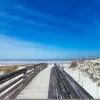
A. Partly. There is accessible parking, a wooden boardwalk out to the sand, accessible restrooms and an accessible wildlife viewing tower.
What there is not is a beach wheelchair. Tigertail does not have one. Clam Pass Park, up the coast in Naples, does list beach wheelchairs among its amenities if that is what you need for the trip.
Q. When should I visit?
A. January through April is the busy season here, and the parking fills earliest then. Gulf water sits around 70 degrees in February, its coolest, and reaches the upper 80s in July and August.
Summer is quieter, hotter and humid with afternoon thunderstorms. It’s worth noting that summer is also when the sand is most restricted, since turtle season and the shorebird nesting closures overlap from May into August.


