





SANTA ROSA BEACH
Where
Snuggled between the Choctawhatchee Bay and the Gulf of America, Santa Rosa Beach is the most extensive beach community in South Walton. Promising miles of glittering white beaches, it’s home to stunning swaths of sand that include Ed Walline Regional Beach Access and Grayton Beach State Park. Deer Lake State Park is among the finest, and is located at 6350 E. County Road 30-A, Santa Rosa FL 32459.
Vibe
Escape the crowds in a natural wonderland.
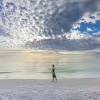
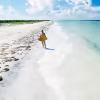
Home to a rare coastal dune lake and beloved by nesting sea turtles and shorebirds, at Deer Lake the sand is sugar white, the waters are a vivid emerald green, and the mood is of peaceful solitude. Here, expect to see dunes with sand so white it looks like an artic landscape; kids splashing in the warm, clear waters; and vast reaches of empty shoreline where you can plant your beach umbrella.
See, feel
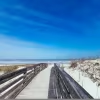
The stroll down the boardwalk to the beach is about ¼ of a mile, so consider bringing a wagon or cart for your beach gear. It’s a soul-soothing expedition that cuts through rolling dunes, with views of Deer Lake and an endangered shorebird nesting area that’s home to least terns and snowy plovers.
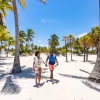
When the beach opens in front of you, it’s a treat for the eyes and for bare toes. Unfolding for half a mile against a pristine backdrop, it’s laden with soft, fine sugar-sand. The water is gin-clear with a blue-green tint, and it’s shallow a long way out, making it ideal for swimming and families.
While the waters are normally calm, winds, tides and offshore systems can occasionally cause rough conditions.
On or near the beach
Activities at Deer Lake include swimming and surf fishing as well as time honored pursuits like hunting for sand dollars, working on your tan, and exploring the shore.
Or hike the park’s two trails, the mile-long Orange Trail, looping through sweet scented pines and deer moss; and the half-mile Blue Trail, rewarding visitors with a scenic overlook of Deer Lake, embellished with Southern magnolias, golden asters, woody goldenrod and scrub oaks.
Deer Lake is beloved by piping plover, little blue heron, reddish egret, white ibis and black skimmers, making it a paradise for birders.
Fuel the fun with a picnic in a shady pavilion complete with a grill.
Accessibility
Deer Lake State Park is dedicated to making the park welcoming to all visitors, with accessible amenities that include ADA parking; picnic facilities with tables and grills; a boardwalk to the beach; and restrooms.
Facilities
Facilities at the park include restrooms (at the parking area), and picnic pavilions with grills.
Lifeguards
There are no lifeguards; swim at your own risk. Visitors are reminded to pay close attention to the Warning Flag Signs posted at the welcome station and on the beach. These flags indicate the swimming conditions.
Parking
Parking, included with the small admission fee, is limited and can fill on holidays and weekends.
FREQUENTLY ASKED QUESTIONS ABOUT SANTA ROSA BEACH
Q. Where is Santa Rosa Beach?
A. Santa Rosa Beach is an unincorporated community in Walton County, on the Gulf coast of the Florida Panhandle. It has no city government of its own, so Walton County runs the beach accesses. See the official Santa Rosa Beach neighborhood guide.
One thing trips up almost every first-time visitor. The Santa Rosa Beach ZIP code covers a wide area that straddles U.S. Highway 98 and runs north to Choctawhatchee Bay, so plenty of addresses labeled Santa Rosa Beach sit nowhere near the sand. The beach itself is along County Road 30A, the two-lane scenic road that connects the South Walton communities.
Do not confuse it with Santa Rosa Island or Santa Rosa County. Those are a different barrier island and a different county, roughly 60 miles west near Pensacola.
Q. Where do I park and walk onto the beach?
A. Use one of the Walton County regional beach accesses. In and around Santa Rosa Beach those are Ed Walline, Gulfview Heights, Blue Mountain, Dune Allen, Fort Panic and Santa Clara. Each has its own free lot, restrooms and a flag pole showing current beach conditions.
Smaller neighborhood accesses are scattered along 30A too, but most have no restrooms and little or no parking. The full map is on the county's beach and bay access page.
Three municipal lots away from the sand started charging in April 2026: the Van Ness Butler lot, the 393 lot and the Grayton Beach lot. The on-site lots at the regional accesses stayed free. Accessible parking (ADA) is free in Walton County, but you must obtain a free Annual ADA Pass to park in designated managed/paid lots. You can register for this pass through the Walton County Parking Portal. Pass options are on the county parking pass page.
From those lots the county runs a free Beach Park and Ride. The Ed Walline Express leaves the 393 lot every 10 minutes and the Dune Allen Local every 30 minutes, all from 10 a.m. to 7 p.m. Blue Mountain Local operates from the Grayton Beach Park and Ride, serving Blue Mountain RBA, Gulfview Heights RBA and the 393 lot. Dune Allen Local includes Topsail Hill Preserve State Park as a regular stop. Between Memorial Day and Labor Day service extends to Grayton Beach State Park. See the official transportation page.
Q. Are the beaches here public or private?
A. Both. A good deal of the dry sand in Walton County is privately owned by the homes behind it.
You can walk the wet sand for all 26 miles of Walton County shoreline, as the area below the mean high-water line is public domain. However, physical obstructions like vendor-placed beach chairs or private property boundary disputes can occasionally make continuous walking difficult in certain private or heavily developed areas. Also, as part of a 2023 settlement agreement, certain property owners are allowing beachgoers to access their private property, using a strip up to 20 feet landward of the wet sand line for walking, jogging and getting into the water, and may sunbathe there with a chair or towel between 9 a.m. and 4 p.m. The county explains it, with a parcel map, on its beach access FAQ.
The simple version: park at a regional access, and you never have to think about it.
Q. Are there lifeguards?
A. At the regional accesses, yes, seasonally. The South Walton Fire District staffs towers March 1 through Oct. 31, from 10 a.m. to 6 p.m., with limited roving coverage the rest of the year.
Deer Lake State Park has no lifeguards at all. Neither do the neighborhood accesses. Even at a staffed tower, coverage ends at 6 p.m., so anyone swimming after that is on their own.
Check the flag before you get in. Green means low hazard rather than safe, yellow means moderate surf or currents, red means high hazard, purple means marine pests, and double red means the water is closed to the public. Entering the Gulf under double red flags carries a fine and criminal charges. Current flag status is posted on the South Walton Fire District surf conditions page, updated twice a day, and you can text SAFETY to 31279 for alerts.
Q. What is Deer Lake State Park?
A. A quiet, undeveloped park at 6350 E. County Road 30A, built around one of Florida's rare coastal dune lakes, with a quarter-mile boardwalk over the dunes to the Gulf. See Deer Lake State Park.
Coastal dune lakes exist in only a handful of places worldwide, and the 30A corridor has 15 of them. They sit close enough to the Gulf that the lake outfall breaches the sand separating the lake and Gulf, permitting an exchange/mixing of fresh and salt water.
saltwater occasionally breaks through and mixes in.
The park is open 8 a.m. until sundown, 365 days a year, with an honor-box entrance fee listed on the park's amenities page. Facilities are restrooms, picnic tables and grills, and two short trails, the one-mile Orange Trail and the half-mile Blue Trail. The lot is small, and the park closes temporarily when it fills, sometimes for a few hours at a time. Come early.
Q. Can I bring my dog to the beach?
A. Almost certainly not. Walton County bars animals from its public beaches except service animals and permitted dogs.
The permit goes only to county residents and property owners, requires proof of current rabies vaccination, and allows a leashed dog on the sand from 3:30 p.m. until 8:30 a.m. the next morning. Visitors staying in a rental do not qualify. Details are on the county's dog beach permit page. Pets are welcome on a leash inside Deer Lake State Park, but not on its beach.
Q. Is the beach accessible if I have mobility needs?
A. It varies by access, so pick the right one. Ed Walline is the strongest choice: it has an accessible boardwalk, accessible restrooms and parking, a free beach wheelchair at Tower 33, and it is the one access with a Mobi-Mat rolled out over the sand.
Santa Clara has a beach wheelchair at Tower 21 plus an accessible boardwalk and restrooms. Dune Allen and Fort Panic have accessible boardwalks, restrooms and parking but no beach wheelchair. Gulfview Heights and Blue Mountain have accessible restrooms and parking without a boardwalk to the sand. Beach wheelchairs go out free from 10 a.m. to 5:30 p.m. daily through the lifeguard season. The county keeps the current list on its accessibility page.
Q. What are the beach rules?
A. They are set out in Walton County's waterways and beach activities ordinance, and code compliance officers do enforce them.
Glass is banned outright, so bring cans or plastic. Tents cap out at 10 feet by 10 feet including straps and legs, must sit on the upland half of the beach, and need a four-foot walkway between them. Umbrellas cap at 8 feet by 8 feet. Holes must be attended, no bigger than 3 feet across and 2 feet deep, and filled in before you leave. Overnight camping on the beach is not allowed.
Then there is Leave No Trace: personal property left on the sand between one hour after sunset and one hour after sunrise will be removed and confiscated. Chairs, tents and coolers all go home with you. Bonfires need a permit from the South Walton Fire District, and those go to Gulf-front property only. See the bonfire permit page.
Q. What about sea turtles?
A. Nesting season in Walton County runs May 1 through Oct. 31, and the county writes those dates into its ordinance. Loggerheads, greens, Kemp's ridleys and leatherbacks all nest here.
South Walton Turtle Watch boils the rules down to clean, dark and flat. Take everything off the sand at the end of the day, fill your holes and knock down sandcastles, and keep lights off the beach after dark, including phone screens and camera flashes. Every property within 750 feet of the mean high water line falls inside the county's wildlife lighting zone. See the South Walton Turtle Watch FAQ and the county's wildlife lighting page. If you find a sick, stranded or entangled turtle, call 850-865-4503.
Q. When is the best time to visit, and how cold does the water get?
A. Spring and early fall are the sweet spot. The lifeguard season, March 1 through Oct. 31, tracks the busy season closely, and crowds run heaviest from June into early August along with spring break and holiday weekends.
The Gulf sits in the low 60s in winter, climbs through the 70s in spring, and reaches the mid-80s by late summer. From December through February most visitors find it too cold for swimming, however pleasant the air feels. Summer brings the warmest water, heat, humidity and afternoon thunderstorms. Here’s info from the area’s visitors services on the weather and when to visit: https://www.visitsouthwalton.com/weather/
Q. Where should I eat?
A. Santa Rosa Beach has a long run of restaurants along 30A and U.S. 98, from breakfast spots to bayfront dining. The Donut Hole, North Beach Social, The Bay, Vue on 30A and Goatfeathers all turn up on the official list.
Browse the full directory on the South Walton dining page, and see the things to do page for paddling the coastal dune lakes, biking the Timpoochee Trail and the rest.


