By Amy Wimmer Schwarb
Discovered only 25 years ago, this remarkable landmark is now a museum and state park that reveals a glimpse into St. Augustine’s lesser known history.
St. Augustine, founded 42 years before Jamestown and 55 years before the Pilgrims arrived on American soil, can boast of the only 17th century fort still standing in North America, the site of the continent's first Catholic congregation and the nation's narrowest street, designed just seven feet wide to impede easy getaway for robbers raiding the nearby treasury.
Yet even among those superlatives, one of the city's most important contributions to American history remained shrouded in myth and mystery until just 25 years ago, when archaeologists uncovered the site of Fort Mose (Mo-ZAY), the first legally sanctioned community of free blacks in what would become the United States.
Fort Mose was considered the city's northern defense against invading British. It was established in 1738 – more than 120 years before the Emancipation Proclamation and 80 years before Florida became a U.S. territory.
The Fort Mose Historic State Park is part of Florida's Black Heritage Trail, a collection of historic sites from Pensacola to Key West that are important in the history of black Americans. The fort is also on the National Register of Historic Places and named as a precursor site on the National Park Service's National Underground Railroad Network to Freedom.
Fort Mose is located just two miles north of the center of St. Augustine, making it an easy side trip from the shops and restaurants of the historic downtown.
The fort's existence was a testament to the power of a promise from the king of Spain – a pledge that captured the attention of African-born slaves in bondage in the Carolinas. Reach St. Augustine and convert to Catholicism, the king decreed in 1693, and you will be free.
Today, Fort Mose's off-the-beaten-path location and the relatively recent discovery of its history combine to inspire and, nearly, require St. Augustine visitors to seek out the Fort Mose Historic State Park. St. Augustine, after all, has just 10,000 people, but several forts: the impressive 23-acre Castillo de San Marcos; Fort Matanzas, built to protect the city from the south; and even a newly built living history museum that calls itself Fort Menendez.
The city's popular tourist trolleys will deliver group tours to Fort Mose, but only by request; it isn't on the regular route.
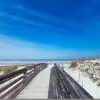
At the park, located on 41 acres purchased by the state of Florida in 1989 (with additional acquisitions in 1998 and 2004) and declared a national landmark in 1994, nothing remains of the fort or the wooden structures where original residents lived. Visitors can explore the grounds and enjoy the boardwalk built on the site.
Beyond the natural setting, the lure of this park is found in the visitor center and museum, which tells a story that is new to many of the people who pass through its doors. The museum reveals how the Spanish worked to strengthen their defenses against England in 1738, building Fort Mose on a creek off the North River and stationing a black militia there to defend the area.
The nation's first community of free blacks grew up around it. Called Gracia Real de Santa Teresa de Mose, it included soldiers and their families, plus artisans and craftsmen. In June 1740, Fort Mose was evacuated as British troops advanced toward St. Augustine, and the British took over the fort. The militia reclaimed it, and the British suffered high numbers of casualties, leading them to call this "The Battle of Bloody Mose."
The fort was largely destroyed, but the community was rebuilt 12 years later. In 1763, when Spain ceded Florida to Britain, the residents of Fort Mose migrated to Cuba, fearing what British rule would mean for former slaves.
The museum also houses many of the artifacts uncovered by University of Florida archaeological researchers in the 1980s, including a brass thimble, some glass beads and fragments of clay pipes. One telling discovery is the remnant of some rosary beads: The former slaves who made their homes in Fort Mose had to adopt the Catholic religion to win their freedom.
The park also hosts special events a few times each year, such as a reenactment of the Battle of Bloody Mose and the "Flight to Freedom," which brings to life the African slaves who escaped the southern British colonies, as well as the Native Americans who helped them along the way and the slave hunters who pursued them.
Thomas Jackson, a member of the Fort Mose Historical Society who has been involved with protecting the land since its history was first traced, now participates as a re-enactor. "We were close to losing this property to developers," Jackson says. "It kind of gives me a sense of enthusiasm to see things that we've done come to fruition."
When You Go...
Take Interstate 95 to State Road 16 East to U.S. Highway 1. Turn north on U.S. 1. Turn right onto Fort Mose Trail, just past the city gates. Go straight to enter Fort Mose Historic State Park, which charges no admission fee. There is a $2 fee to enter the museum at the visitor center, which includes a video that adds context to the Fort Mose story. The visitor center and museum are open 9 a.m. to 5 p.m. Thursdays through Mondays. The park grounds are open daily, 8 a.m. to sundown, 365 days a year. For information, visit the Fort Mose Historic State Park at floridastateparks.org/fortmose or the Fort Mose Historical Society at fortmose.org.