








You've Gotta Try This: Scuba Diving Devil's Den in Williston
There's a moment, partway down the staircase, when the sound of the outside world drops away.
You've just left a Florida parking lot in April sunshine, walked past picnic tables under oak trees, and followed a narrow wooden staircase into what looks like a hole in the ground. The stairs are steep. They get wet. Signs remind you to descend one person at a time. And then the air changes, cool and damp instead of warm, and the staircase opens into a chamber 120 feet across with turquoise water below and a shaft of sunlight pouring through a hole in the ceiling.
This is Devil's Den. And whatever you pictured when you heard "underground spring in Williston, Florida," it wasn't this.
National Geographic has ranked Devil's Den among the top 100 dives in the world. Once you're standing at the bottom of that staircase, looking at the water, you understand why.

It’s difficult to take it all in when you first arrive at the main attraction and begin to descend the staircase of Devil’s Den.
What You're Actually Looking At
The chamber is a karst window: a collapsed section of limestone cave where the roof gave way long enough ago that nobody remembers. Fossils from the Pleistocene Age have been unearthed from the cave walls, from back when giant sloths and mastodons walked the area and, presumably, drank here. The water is spring-fed and holds at 72 degrees year-round, like most Florida springs. But unlike the others, this one lives inside a cave.
Early settlers named it Devil's Den because on cold winter mornings, warm air from the spring meets cold air above and creates steam that rises from the opening. If you've never seen vapor curling out of a hole in the ground at dawn, it does look a little like a door to hell.
The den is 50 feet deep with no shallow areas. The walls drop straight down. Tendrils of vegetation hang from the opening above. When the sunlight hits the water at the right angle, it cuts through like a spotlight and turns the whole chamber electric blue. That's the image you'll see in every photo of this place, and it's not staged. It happens on its own, most hours of most days.

When air temperatures are cold and you arrive early in the morning, you can see steam rising from the opening in the ground above the spring: the spectacle that led to the name “Devil’s Den.”
Snorkeling: What the Experience Is Like
You don't need certification. You need to be a good swimmer, and you need a reservation (no exceptions, book through the Devil's Den website). You'll get 90 minutes in the water.
The water will feel cold. Seventy-two degrees year-round sounds warm, and in direct sun at a conventional spring it would be. Inside a cave with no sun warming your exposed skin between swims, it feels cooler than the number suggests. A wetsuit isn't required and many people skip it, but if you're in the water longer than about 20 minutes or you run cold in general, renting a 3mm suit for the session will make a difference.
What you'll see through a mask: visibility that makes it feel like there's no water at all. The limestone ledges drop away into deeper blue. Divers below appear small and slow-moving. Light rays cut through the water in distinct beams that shift as the sun moves across the opening above. If you float still and just look, you can watch the patterns change.
Keep an eye out for Nelson. He's a resident turtle and he's been at Devil's Den for years.
You can't swim laps here. You can't splash around. You have to wear the mask, snorkel, and fins for the full session (they're required equipment, not a suggestion). No flotation devices. No freediving fins. No breath-holding below 8 feet. The facility is strict about this, and once you understand the setup, you understand why: this is an underground chamber with one narrow staircase in and out, and they need every person in the water to be self-sufficient.
Snorkeling pricing: $30 per person for the 90-minute session, which includes access to John's Oasis. A $5 non-refundable deposit books the spot; the remaining $25 is paid on arrival. Equipment rental is $15 for the full bundle (mask, snorkel, fins), or $5.50 each if you only need one item.

A day spent at Devil’s Den is an adventure into a new world and a Florida spring like you’ve never experienced.
Scuba Diving: A Different Angle on the Same World
If you're Open Water certified or above, you can dive Devil's Den seven days a week. No reservation needed for daytime dives. You show up, show your card, sign the waiver, and get in the water.
What makes this site work for divers across experience levels is the layout. The chamber is contained, the exit is always visible (that shaft of light overhead), and the deepest point is 50 feet. You can't wander into tight passages or overhead environments. There's no current, no surge, no surface chop. Instructors bring students here to teach buoyancy because the environment doesn't fight you.
For more experienced divers, the reward is different. Kiki from Live Free Diving puts it well in her visitor video: it's "like going into another world." There are small caves and crevices to explore along the perimeter. Limestone formations ancient enough that running your hand along them feels like touching something that shouldn't be touched. The light from above gets dimmer and bluer as you descend, and at 40 feet, the silence is the kind you don't often get in the ocean.
Night dives are available by appointment with seven days' notice. Divers must be Advanced certified or accompanied by an instructor, and the minimum group rate applies ($480 for under 10 divers).
Scuba pricing: $48 admission. Air fills $10.50 (no nitrox). Full gear bundle $60 (everything you need including a wetsuit, weights, and LED light). Individual rentals range from $5.50 up to $25. Night dives $48 per diver with a $480 minimum.
A few rules worth knowing going in: dive buddy required at all times, no exceptions. No doubles, reels, rebreathers, knives, side-mounts, or pony tanks for recreational divers. No cave entry (the chamber itself is open-water; the passages beyond are off-limits). Don't touch or remove rocks or fossils.

Among the Sunshine State’s dozens of dazzling, crystal-clear freshwater springs, Devil’s Den stands in a class of its own.
John's Oasis: The Non-Spring Option
If you're traveling with family members who aren't diving or snorkeling, or you just want a swim without the gear, John's Oasis solves that problem.
It's a swimming pond on the Devil's Den property, separate from the spring itself, restored by the facility's maintenance crew under the leadership of a guy named John. Regular swimming is allowed here. No age limits (unlike the den, where children under 6 aren't permitted). No wildlife in the water. Certain areas are deep so strong swimming is still recommended, and there's no jumping or diving in, but it's the loosest water option on the property.
Pricing: Included free with any lodging or snorkeling reservation. $15 if used on its own. $10 add-on if you've paid the $48 dive admission and want to dive the Oasis too.
Practical Details That Save You a Trip
Hours: Open 364 days a year, closed only on Christmas Day. Monday through Thursday, 9:00 AM to 4:30 PM. Friday through Sunday, 8:00 AM to 5:00 PM. On diving days, last entry is 3:00 PM (M-Th) or 4:00 PM (F-Su), and everyone must be out of the water 20 minutes before closing.
Location: 5390 NE 180th Ave, Williston, FL 32696. About 30 minutes from Gainesville. Under two hours from Jacksonville, Tampa, or Orlando.
Reservations: Snorkeling requires one, no exceptions. Diving does not (first come, first served). Lodging does.
Age policy: Children under 6 aren't allowed in the den at all. Minors under 18 need a legal guardian on site or a notarized parental consent form. John's Oasis has no age restriction but supervision is expected.
What to bring: Swimsuit, towel, change of clothes. A wetsuit if you run cold or plan a long session. Waterproof phone case or camera if you want photos. Snacks and drinks; there's a small gift shop with basics, but picnic tables are available and charcoal grills work too. Phones and cameras are allowed in the den for snorkelers; divers leave valuables in the car.
Non-swimmers who want to look: The only entry is that narrow staircase, and there's nowhere to stand at the bottom that doesn't block other people. A $7 fee gets you access to the rest of the property. A walkway above the opening lets you peer down into the water from ground level, which is worth doing even if you're diving.
Accessibility: The cave opening is 56 stairs down a narrow stairway, so it's not wheelchair accessible. The sidewalk, restrooms, showers, office, and gift shop are all ADA accessible.
No pets (except in the RV park, leashed, and service animals). No alcohol during business hours.
Check out the Devils Den website for up-to-date details.
Other Springs and Attractions in the Area
Williston itself isn't a destination town, but the surrounding region has one of the densest concentrations of world-class springs in Florida. If you're making the drive to Devil's Den, it's worth building the trip out to hit two or three more sites while you're there. Each has its own personality, and the variety makes for a better weekend than any single spring could.
Blue Grotto is about 2 miles from Devil's Den and offers a completely different cave diving experience. Where Devil's Den is a single open chamber with sunlight pouring in from above, Blue Grotto is a true cavern system: overhead passageways, multiple connected rooms, and deeper exploration for divers with cavern training. Cave-certified divers can continue into the cave section beyond the cavern. It's also open to snorkelers at the surface, so non-divers in your group aren't shut out. If you're diving both in one day, morning at Devil's Den and afternoon at Blue Grotto is a classic pairing.
Rainbow Springs State Park is twenty minutes south in Dunnellon. It's the opposite experience from Devil's Den: open-air, wide, shallow, with a mile-long spring run that you can tube, swim, or kayak through. The water is the same 72 degrees, but with the sun on you the whole time, it feels warm. Rainbow Springs is the family-friendly choice, especially for anyone who didn't enjoy the cave environment or has kids too young for Devil's Den. There's also camping, a gift shop, and old walking trails through former tourist-era gardens.
Manatee Springs State Park is about 45 minutes northwest, on the Suwannee River. It's known for what the name suggests: manatees gather in the warm spring run during the colder months, typically November through March. You won't see them in summer. But year-round, it's an open-water spring with a boardwalk through the cypress swamp, a designated swimming area, and kayak rentals for paddling the spring run out to the Suwannee. It's the wildlife-focused stop if Devil's Den is the geology stop.
Cedar Lakes Woods and Gardens is literally next door to Devil's Den. It's a botanical garden built into an old limestone quarry, with self-guided walking trails through layered plantings and dramatic rock formations. Two or three hours is enough. Most people who combine the two do the garden first and Devil's Den second, since you'll want dry clothes and a relaxed afternoon after the spring rather than a hike.
Crystal River is about 45 minutes south and worth mentioning if you're building a longer trip. It's one of the best places in the world to swim with manatees, and operators run guided tours out to Three Sisters Springs during manatee season.
A sensible two or three day itinerary from Devil's Den: half a day at Devil's Den, afternoon at Cedar Lakes or Blue Grotto, second day at Rainbow Springs or Manatee Springs depending on the season, third day for Crystal River manatees if you came in winter or a drive down to Ocala for the horse country if you didn't.
The Real Reason to Go to Devils Den
There are dozens of crystal-clear springs in Florida. Most of them are beautiful. Most of them are open to the sky, with grassy banks and manatees and tubers floating through in summer.
Devil's Den is the one you descend into.
That's the thing no photo quite captures. The moment of walking down into shadow, the drop in temperature, the way the sound changes, the first time you look up and see the shaft of sunlight hitting the water. You're inside the geology, not beside it. You float in a pool that's been sitting at exactly 72 degrees for longer than humans have been around to measure it, and 20 feet above your head, Florida is carrying on like normal.
It's worth the drive. It's worth the reservation hassle. It's worth the wetsuit money if you run cold.
FREQUENTLY ASKED QUESTIONS ABOUT DEVIL’S DEN
Q. What is Devil's Den?
A. A privately owned pre-historic underground spring inside a 120-foot-wide limestone cave in Williston, Fla. Water stays at 72°F year-round. Fossils from the Pleistocene Age have been recovered from the cave walls. National Geographic has ranked it among the top 100 dives in the world.
Q. Where is Devil's Den located?
A. Devil's Den is at 5390 NE 180th Ave in Williston, Fla., a small town in the north-central part of the state. It's about 30 minutes southwest of Gainesville and roughly 45 minutes east of Cedar Key. Williston itself sits on the edge of Levy County, surrounded by horse country, oak hammocks, and some of Florida's best spring diving.
Q. How far is Devil's Den from Orlando?
A. Devil's Den is about 100 miles northwest of Orlando, roughly a two-hour drive depending on traffic. Most visitors take I-75 north to Ocala, then follow US-27 west through Williston. It's a reasonable day trip from Orlando if you start early, though an overnight stay (either at Devil's Den's on-site lodging or somewhere in Ocala or Gainesville) lets you enjoy the spring without rushing. From Tampa, it's about the same distance. From Jacksonville, closer to 90 minutes.
Q. Do I need scuba certification?
A. For diving, yes: Open Water certification at minimum. Snorkeling doesn't require certification but does require strong swimming ability. The den is 50 feet deep with no shallow spots and no flotation devices allowed.
Q. How cold is the water really?
A. 72°F year-round. That sounds warm, but the cave environment keeps the air cooler than outside, so your body loses heat faster between swims than it would at an open-air spring. Most people are fine without a wetsuit for short sessions. For 45 minutes or more, or if you run cold, rent a 3mm suit.
Q. Do I need a reservation?
A. Snorkeling requires one, no exceptions, with a $5 non-refundable deposit. Daytime diving does not (first come, first served). Night dives require appointment at least 7 days in advance. Lodging reservations are required for cabins and the RV park, and recommended for tent camping.
Q. Can kids do this?
A. Children under 6 aren't allowed in the den at all. Kids 6 and older can snorkel if they're strong swimmers (no flotation devices permitted). Minors under 18 need a legal guardian on site or a notarized parental consent form. John's Oasis, the on-site swimming pond, has no age limit and is a good option for younger kids while parents dive or snorkel.
Q. What fossils have been found here?
A. Fossils from the Pleistocene Age, including remains of species that went extinct after the last Ice Age. Most have been removed by paleontologists for study and preservation over the years, but the geological context remains and the cave walls themselves tell the story.
Q. Is there camping?
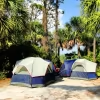
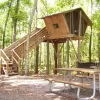
A. Yes. Four cabins (sleep up to 4 each, $115-$160/night depending on length of stay, must be 21 or older to book), primitive tent sites ($22/person, kids 6 and under free), and 32 RV sites with full hookups ($48-$58/night). Campers get early access before day visitors arrive, which is when steam rises from the opening on cold mornings. Campground guests also get free access to John's Oasis.
Q. What gear do I need for snorkeling?
A. Mask, snorkel, and fins are required at all times in the water. You can bring your own or rent on site ($15 for the full bundle, $5.50 each for individual items). No long freediving fins. No flotation devices.
Q. How deep is it?
A. The den is 50 feet deep with no shallow areas. The walls drop straight down. Multiple platforms at different depths let divers control their descent.
Q. What are the actual hours?
A. Open 364 days a year, closed only on Christmas Day. Monday through Thursday: 9:00 AM to 4:30 PM. Friday through Sunday: 8:00 AM to 5:00 PM. On diving days, last entry is 3:00 PM Monday through Thursday and 4:00 PM Friday through Sunday. Everyone must be out of the water 20 minutes before closing.
Q. Can I just swim without snorkeling or diving?
A. Not in the den itself. Only snorkeling and diving are allowed in the spring, and you'll need the proper equipment to enter the water. John's Oasis, the on-site swimming pond, is open for regular swimming and is included with any lodging or snorkeling reservation.
Q. Can I just walk down and look without getting in the water?
A. Access to the staircase isn't guaranteed for non-swimmers. The entrance is narrow and leads directly into the water, with nowhere to stand that doesn't block guests entering or exiting. A $7 fee gets you access to the rest of the property, including the walkway above the opening where you can look down into the water from ground level.
Q. What other springs should I visit nearby?
A. Blue Grotto (30 miles, cavern diving and surface snorkeling), Rainbow Springs State Park (20 minutes south in Dunnellon, open-air spring for tubing and family swimming), Manatee Springs State Park (45 minutes northwest, manatee viewing in winter months), Cedar Lakes Woods and Gardens (next door to Devil's Den, botanical garden in an old quarry), and Crystal River (45 minutes south, manatee tours in winter).
Q. Are pets allowed?
A. Not in the den, cabins, or tent area. Leashed pets are allowed in the RV park only. Service animals are accommodated; emotional support animals are not.
Q. Can I bring alcohol?
A. Not during business hours. Overnight lodging guests 21 and over may have alcohol in the campground, not the cave.


