






Here are some facts about Florida's climate, land, waters, outdoors, animals, theme parks, and culture.
Climate
Florida enjoys a warm climate throughout the year, although temperatures and weather conditions vary from north to south. The northern part of the state has a humid subtropical climate, while South Florida has a tropical climate. Warm, right?
Ocean and Gulf waters can reach well into the 80s during summer, making swimming and water activities popular throughout the year, particularly in South Florida.

The Land
Florida has 1,350 miles (2,172 kilometres) of coastline and hundreds of miles of sandy beaches to enjoy.
It's the only U.S. state that borders both the Atlantic Ocean and the Gulf of Mexico.
The state's highest natural point, Britton Hill, stands just 345 feet (105 metres) above sea level – the lowest high point of any U.S. state.
Key West is home to the famous Southernmost Point Buoy, marking the southernmost point of the contiguous United States.
Outdoors
Florida offers an extensive network of hiking, bicycling, equestrian and shared-use trails, along with numerous opportunities for paddling, camping and exploring the great outdoors.
The state is home to 175 state parks, three national forests and numerous national park sites, including national parks, preserves, seashores and monuments.
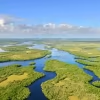
The Florida Everglades, encompassing approximately 1.5 million acres of sawgrass marshes, mangrove forests, hardwood hammocks and wetlands, is the largest subtropical wilderness in the United States.
Kissimmee Prairie Preserve State Park is Florida's first designated International Dark Sky Park, offering some of the state's best opportunities for stargazing.
Florida also has more golf courses than any other U.S. state, making it a favorite destination for golfers.
Water
Florida is the boating and fishing capital of the world.
The state has approximately 7,700 lakes, 11,000 miles of rivers and streams, and 2,276 miles of tidal shoreline. Florida also holds more current International Game Fish Association world fishing records than any other U.S. state.
Florida has more large freshwater springs than any other state, including 33 first-magnitude springs. Their remarkably clear waters are ideal for swimming, snorkeling, kayaking and wildlife viewing.
Fort Lauderdale is known as the Venice of America because of its extensive canal system, with more than 165 miles of local waterways.
The fishing village of Cedar Key is renowned for its seafood, particularly its locally harvested clams and signature clam chowder.
The 156-mile-long (251-kilometre) Indian River Lagoon is one of North America's most biologically diverse estuaries.
Florida's longest river, the St. Johns, stretches 273 miles (439 kilometres) and is one of the few major rivers in the United States that flows predominantly from south to north.
John Pennekamp Coral Reef State Park on Key Largo was America's first underwater state park, protecting a spectacular section of the Florida Reef.
Fauna
Florida is home to an extraordinary variety of wildlife, including alligators, crocodiles, panthers, sea turtles, manatees and dolphins, as well as hundreds of bird species.
South Florida is the only place in the world where American crocodiles and American alligators coexist in the wild.
Florida provides important habitat for numerous threatened and endangered species, including the West Indian manatee, Kemp's ridley sea turtle, Florida panther, Key deer, whooping crane and Gulf sturgeon.
Crystal River and Kings Bay are the only places in Florida where visitors can participate in supervised in-water manatee viewing, subject to strict wildlife-protection rules.
The Great Florida Birding and Wildlife Trail is a statewide network of wildlife-viewing sites that showcases the state's remarkable birdlife and diverse habitats.
Between Sugarloaf Key and Big Pine Key, en route to Key West, you'll find habitat for the elusive Key deer, the smallest deer in North America.

Universal Orlando Resort, Diagon Alley at the Wizarding World of Harry Potter
-Universal Orlando
Theme Parks, Attractions
Florida is a theme park epicenter, home to some of the world's best-known family entertainment destinations, including Walt Disney World Resort, Universal Orlando Resort, SeaWorld, LEGOLAND Florida and Busch Gardens Tampa Bay.
Orlando is home to some of the most visited theme parks in the United States, making it one of the world's leading destinations for theme park vacations.
Walt Disney World Resort, which opened in 1971, is one of the world's most visited vacation destinations and home to four major theme parks.
Florida also boasts an impressive collection of water parks, offering everything from thrilling slides and wave pools to relaxing lazy rivers and family-friendly attractions.
At Weeki Wachee Springs State Park, visitors can enjoy the famous live mermaid performances, a Florida tradition that dates back to 1947.
Culture
Florida is a melting pot of cultures, with Native American, European, African American, Hispanic and many other influences reflected in its cuisine, architecture, art and traditions.
The urban graffiti art of Miami's Wynwood Walls draws artists and visitors alike to this vibrant neighborhood, where colorful murals, galleries, walking tours and breweries contribute to the creative atmosphere.
St. Petersburg's SHINE Mural Festival has brought artists together to transform buildings throughout the city into large-scale works of public art.
Salvador Dalí's extraordinary collection of paintings and other works can be found at The Dalí Museum in St. Petersburg.
The Charles Hosmer Morse Museum of American Art in Winter Park houses the world's most comprehensive collection of works by Louis Comfort Tiffany.
Circus impresario John Ringling amassed a world-class collection of European paintings, including works by Peter Paul Rubens, Marcel Duchamp and Diego Velázquez. Today, the collection is housed at The Ringling in Sarasota. The complex also includes the couple's historic mansion, Ca' d'Zan, and the Circus Museum, celebrating Florida's important place in the history of the traveling show.
Miami Beach is one of four international Art Basel host cities, alongside Basel, Hong Kong and Paris, bringing leading galleries, artists and collectors together each year.
Agriculture
Florida's farms produce a wide variety of fruits and vegetables, including oranges, grapefruit, tomatoes, strawberries, sweet corn, snap beans and cucumbers.
The state is a leading U.S. agricultural producer, ranking first nationally in crops including cucumbers, watermelon and sugarcane for sugar.
History
Spanish explorer Juan Ponce de León named the region La Florida after arriving in 1513 during Pascua Florida, the Spanish celebration of Easter, also known as the Feast of Flowers.
Founded by the Spanish in 1565, St. Augustine is the oldest continuously occupied European-established settlement in the continental United States.
The world's largest single-site collection of Frank Lloyd Wright architecture can be found at Florida Southern College in Lakeland.
Florida's spring training tradition dates back to 1888. Today, 15 Major League Baseball teams train in the Sunshine State.
Cape Canaveral and nearby Kennedy Space Center have played a central role in American space exploration, serving as launch sites for the Mercury, Gemini, Apollo and space shuttle programs.
The world's first scheduled commercial passenger airline service operated between St. Petersburg and Tampa, beginning Jan. 1, 1914.
Daytona Beach's Jackie Robinson Ballpark hosted the first integrated professional baseball game of the modern era on March 17, 1946, when Jackie Robinson took the field for the Montreal Royals.
NASA's first communications satellite, Echo 1, was launched from Cape Canaveral on Aug. 12, 1960.
More Florida Facts
Florida's airports connect travelers with destinations across the United States and around the world through an extensive network of domestic and international flights.
Miami Beach is home to the world's largest collection of Art Deco architecture, with more than 800 historic buildings.
Florida is the only U.S. state with an "embassy" in Washington, D.C. Florida House on Capitol Hill serves as a gathering place and cultural ambassador for the Sunshine State.
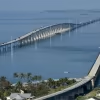
Florida has 27 designated scenic highways and byways, including six with National Scenic Byway designation and two designated as All-American Roads. The Florida Keys Scenic Highway is one of the state's two All-American Roads. WHAT’S THE OTHER ONE?
Pelican Island is the site of America's first national wildlife refuge, established by President Theodore Roosevelt in 1903.
Sanibel and Captiva, near Fort Myers, are popular resort destinations known as the Seashell Capital of the World.
By land area, Jacksonville is the largest city in the contiguous United States, encompassing more than 840 square miles (2,176 square kilometres).
Olustee was the site of Florida's largest Civil War battle, fought in February 1864.


