




Florida Welcome Center
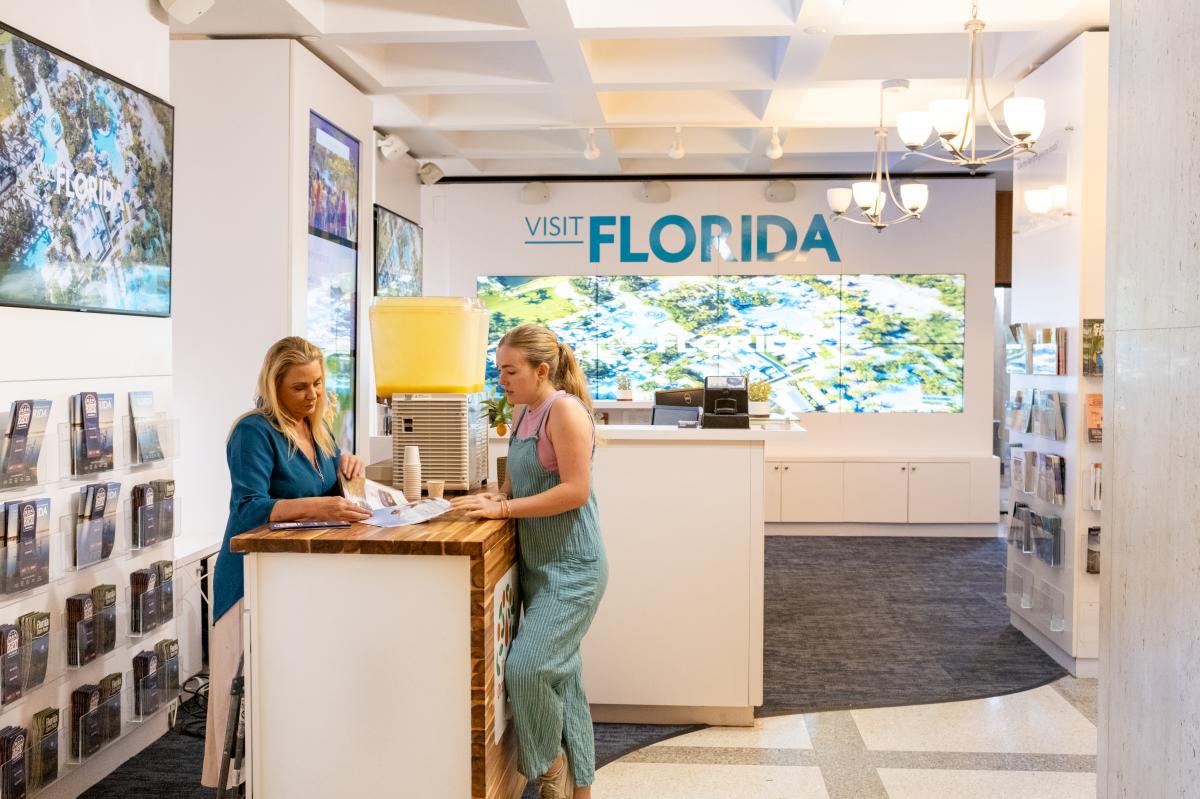
Our self-guided tour begins at the Florida Welcome Center, open Monday through Friday, 8 a.m. to 5 p.m. Here, you’ll find information on the Sunshine State and the Capitol complex while, during the legislative session, enjoying complimentary fresh Florida orange juice. Adorning the west-facing walls are two murals by Florida Artists Hall of Famer James Rosenquist titled: “Images of the Sunshine State.” These collages represent Florida’s natural beauty, and the industries that support our economy: space exploration; recreation; timber; and agriculture. Noteworthy images include a traditional Seminole dwelling known as a chickee, and a citrus peel flattened into the form of an orange blossom—our state flower. Also portrayed are a variety of state animals such as the alligator, mockingbird, and zebra longwing butterfly.
The Heritage Chapel
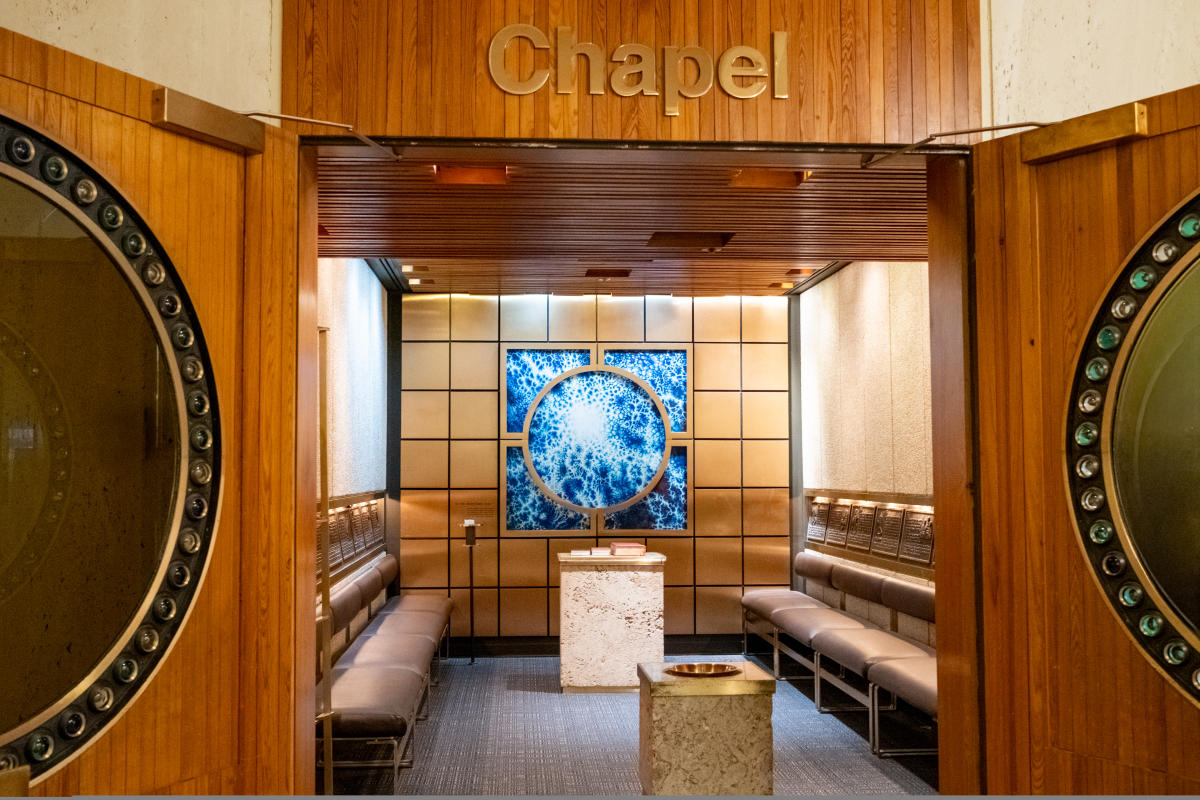
Completed in 1980 and dedicated as a meditation room, The Heritage Chapel is decorated with Florida-sourced materials. Its walls are made from coquina, from the St. Augustine region, while the ceiling is tidewater cypress that was submerged in the Apalachicola River for more than 50 years before reclamation. The baptismal font and table are constructed of quarry keystone from Florida City. And, a series of brass plaques on the chapel’s walls traces Florida’s religious heritage from the original inhabitants through the arrival of Catholic conquistadors, Franciscan missionaries, English Episcopalians, plus Jewish, Methodist, and Greek Orthodox settlers. The painting, “Creation,” by pop artist Gene Walsh, symbolizes “The mystery of ordering ourselves, through God, out of the chaos of a natural world.” The brass gates have a circular Asian motif and were originally installed to protect gold artifacts on display from the Museum of Florida History. The chapel doors continue the circular design, embedded with colorful balls of sea glass curated from our shores.
The Rotunda
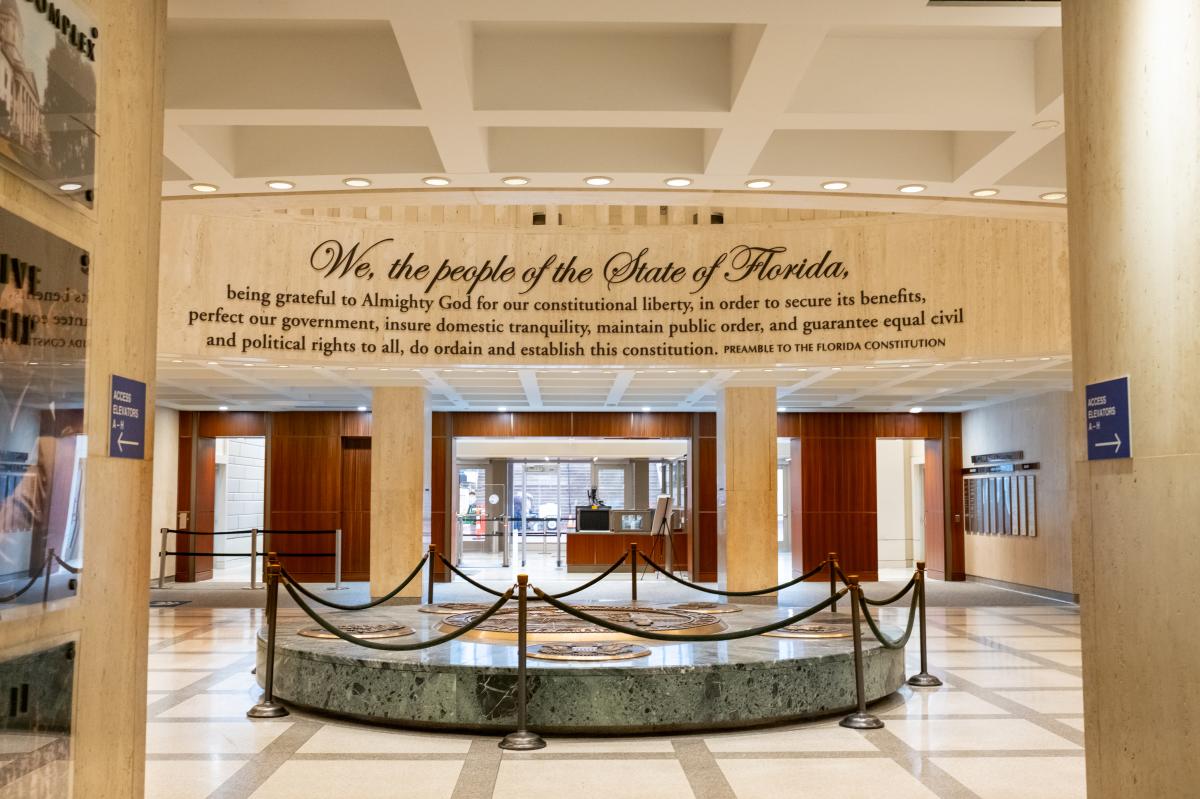
On the east side of the Plaza Level, you’ll find The Great Seal of Florida— the centerpiece of the rotunda. Five smaller seals surrounding the Great Seal represent the five powers central to Florida’s history: France; Spain; the United Kingdom; the Confederate States; and the United States of America. Showcased on the rotunda walls, you’ll find the names of Floridians honored in: the Florida Women’s Hall of Fame, Florida Veterans Hall of Fame, Florida Civil Rights Hall of Fame, Florida Artists Hall of Fame, Florida Law Enforcement Officers Hall of Fame, and the Florida Tourism Hall of Fame. Additional walls honor Florida’s Medal of Honor recipients, and those who made the ultimate sacrifice on the Fallen Firefighter Wall of Honor.
Offices of the Governor & Cabinet Officials
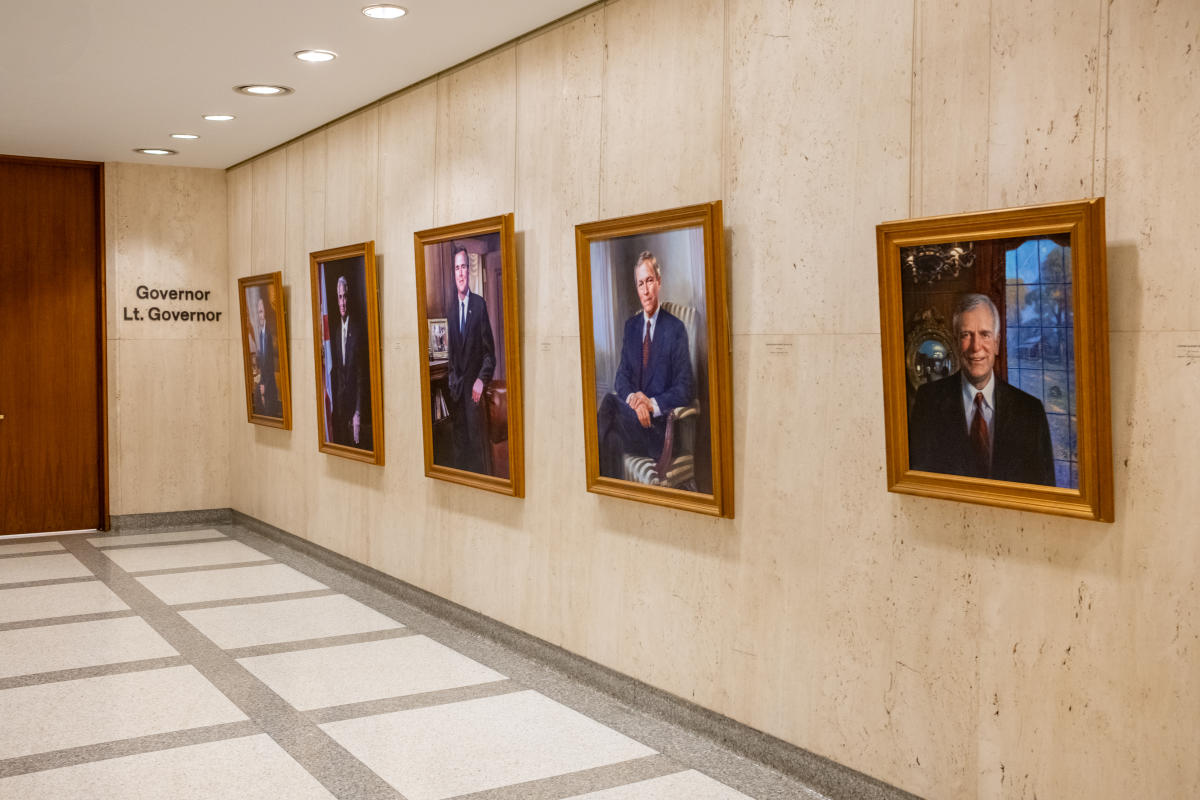
South of the rotunda, a hallway lined with portraits of previous governors leads to the offices of Florida’s executive branch: the governor; lieutenant governor; and attorney general. North of the rotunda are the offices of the chief financial officer and commissioner of agriculture. Meetings of the governor and Cabinet are open to the public and take place in the Cabinet meeting room located on the lower level of the Capitol building.
The 5th Floor
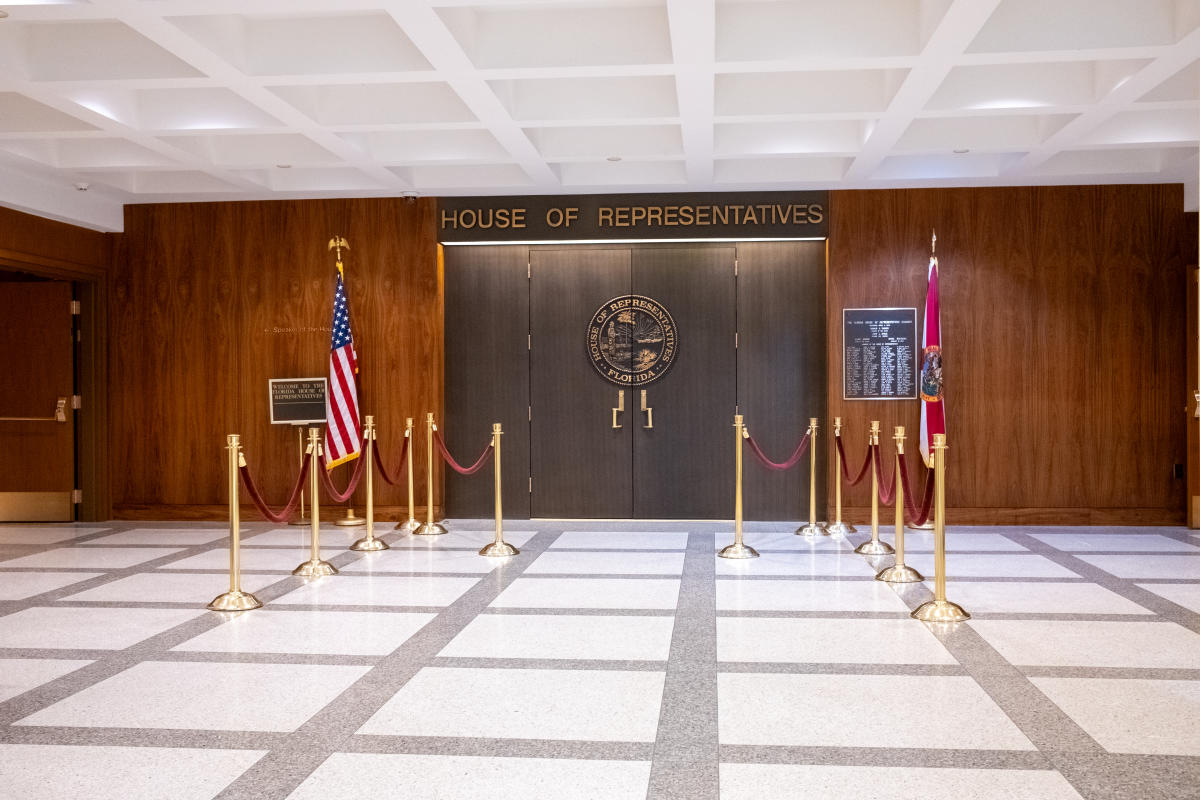
The viewing galleries for the House and Senate chambers are located on the 5th floor. Look for a list of noteworthy Florida facts on the rotunda walls between the 4th and 5th f loors, such as our state animal—the Florida panther, state bird (mockingbird) state tree (sabal palmetto palm) and even our state pie (Key lime). On the 4th floor, you’ll also enjoy a faithful reproduction of the Historic Capitol constructed from approximately 370,000 Lego blocks, courtesy of LEGOLAND. Our public viewing galleries require quiet observation during session. No cheering, clapping, or flash photography is allowed, and any disturbance could be grounds for ejection.
The Senate Chamber
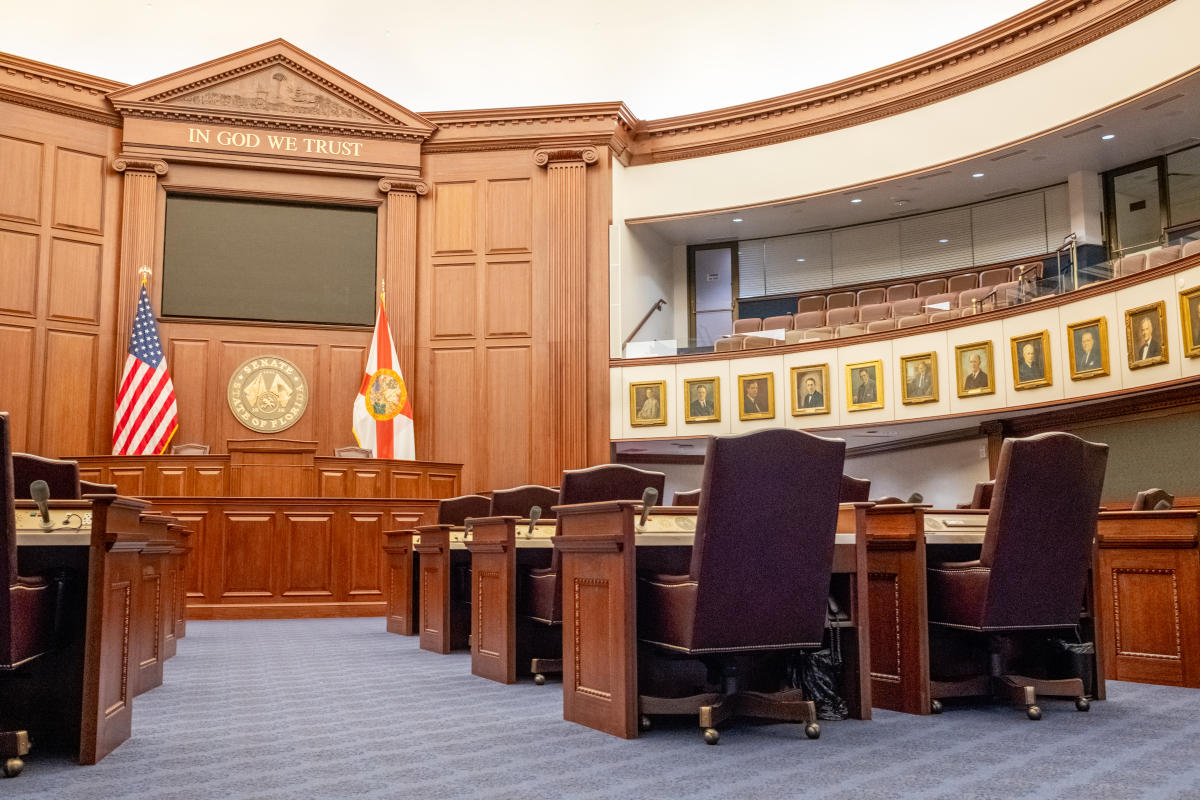
Comprised of 40 members, the Florida Senate is elected under a staggered election cycle—half every two years. A glass-enclosed press box is provided next to viewing galleries for the general public. Underneath each gallery a voting board is displayed, allowing members of the Senate and public to see how each legislator voted. Democrats traditionally are seated on the presiding officer's right; Republicans on the left. Each senator’s desk has four buttons—red and green for voting, yellow to call a page or messenger, and a white button, used to communicate a phone call from their office. A light from the apex of the dome replicates the stained glass design of the Historic Capitol’s dome, illuminating a list of Florida’s 67 counties and portraits of former Senate presidents surrounding the chamber.
The House of Representatives Chamber
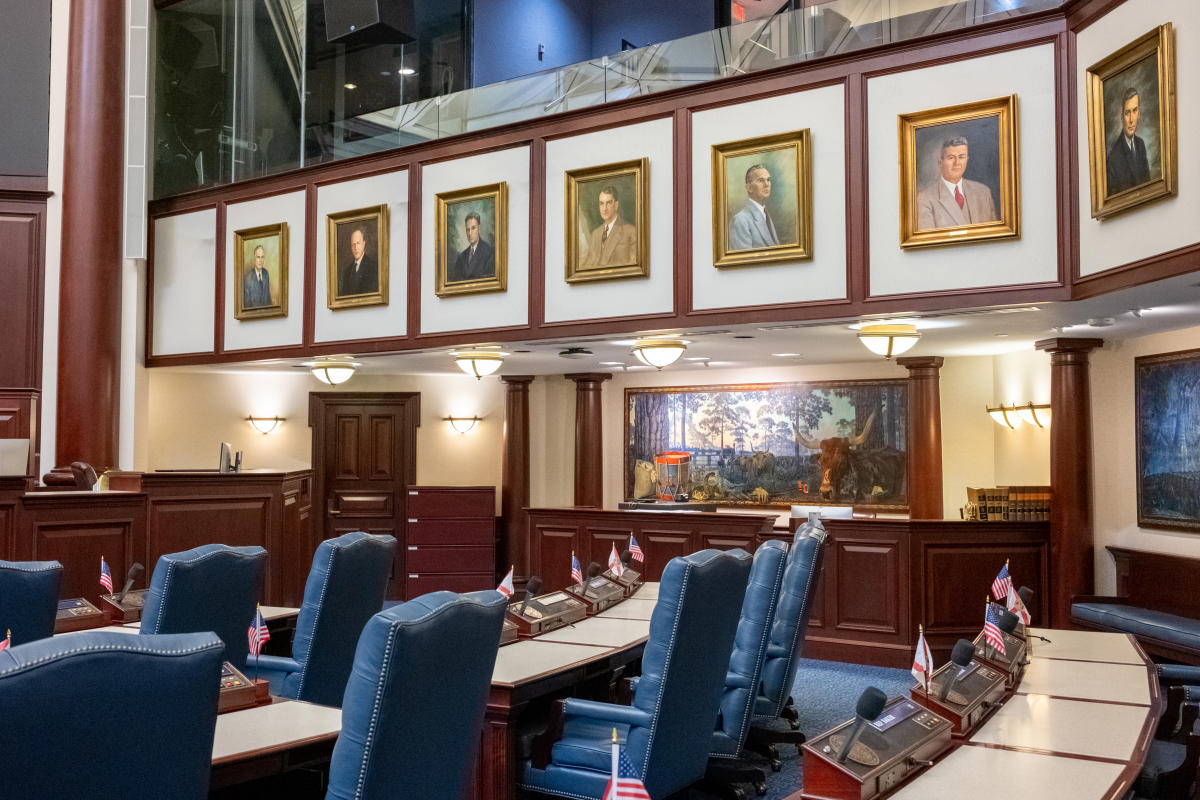
The Florida House of Representatives is comprised of 120 members. Unlike in the Senate, representatives’ desks have only three buttons under their nameplate—green and red for voting, and a yellow button to summon a House page. Decorum is maintained through established rules and a code of ethics that govern the conduct of members. When a representative requests to speak to the House, they simply raise a hand. When called upon by the speaker, their microphone is turned on, and all others are muted. The House Chamber is a little more colorful than the Senate, adorned with exquisitely detailed murals by Christopher Still of Tarpon Springs, depicting Florida’s history, starting with a native Floridian witnessing the arrival of Spanish ships. Two additional scenes of freshwater and saltwater represent Florida’s diverse ecosystem. And, ringing the top of the Chamber are portraits of former speakers of the House.
22nd Floor Observation Deck
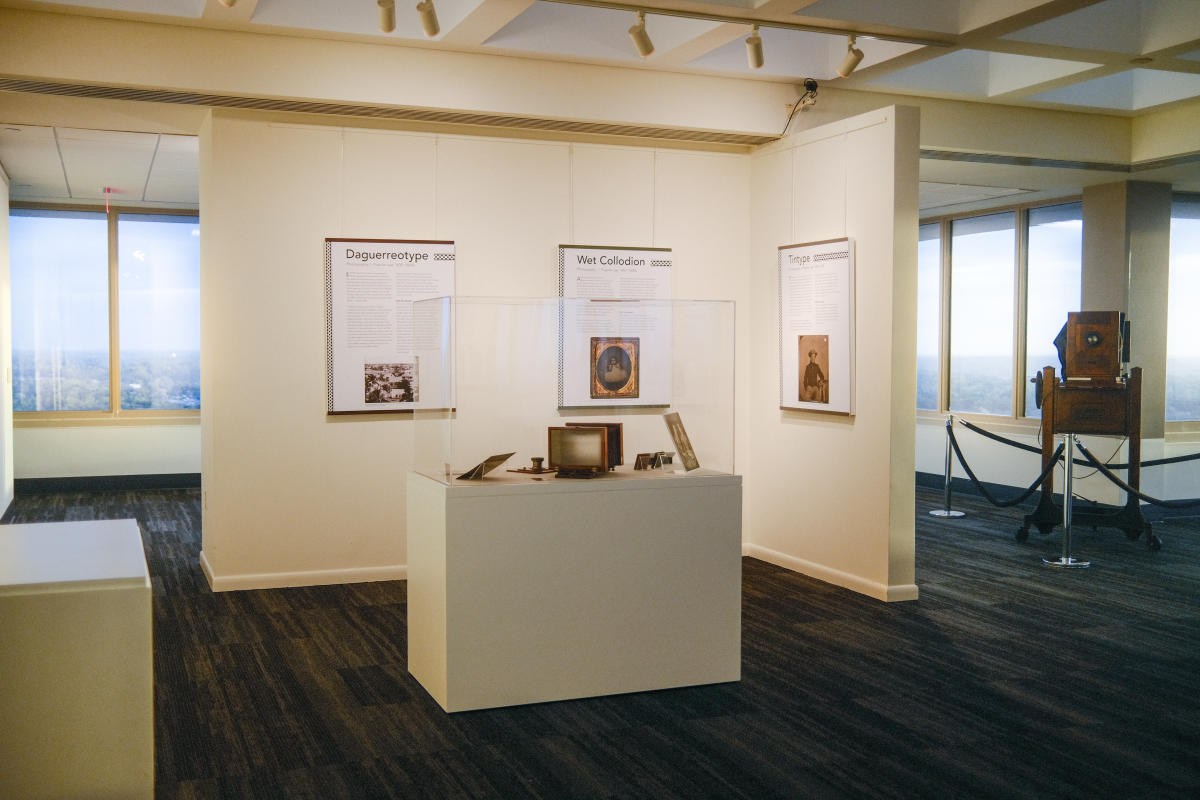
The 22nd floor is as high as it gets in Tallahassee—512 feet above sea level. This enclosed observation deck provides convenient kiosks indicating points of interest. On a clear day, you can see for 20 miles—all the way to our state line to the north. Notable landmarks are Florida State University, Florida A&M University, and Tallahassee State College. Approximately 65,000 students attend Tallahassee’s institutions of higher learning, almost doubling the population during academic terms. The brick building directly in front of the Capitol is the Tallahassee City Hall. If you notice that a curved section appears to be missing, it’s not by accident. A block to the right is the Leon County Courthouse, featuring a curved green glass wall completing the missing section of City Hall. This represents the city and county working together to benefit the citizens. To the east, you’ll notice an impressive 30-foot flag indicating the Vietnam Veterans Memorial. Nearby is Cascades Park—the site of the original waterfall that enticed pioneers to settle in the area. This is also the location of Florida’s Prime Meridian Marker, the point from which everything in the state is surveyed. The 22nd Floor also features The Capitol Gallery—displaying rotating exhibits by Floridian artists and the occasional guest exhibit, such as the works of Salvador Dali, or traditional Japanese art from Wakayama Prefecture, Florida’s sister state. The Freedom Shrine is not to be missed—it’s a collection of historical document reproductions such as the Declaration of Independence, the Constitution and Bill of Rights, instruments of surrender from Imperial Japan and Germany, and famous speeches such as The Gettysburg Address, John F. Kennedy’s inaugural address, and Dr. Martin Luther King’s iconic “I have a Dream.” The observation deck is easily accessed by elevator but you’re always welcome to follow our 43rd governor’s lead and take the stairs—all 499 of them.
STRATEGIC ALLIANCE PARTNERS


