













Lake Apopka, Florida's second-largest lake, doesn't get the attention it should. Restoration efforts are bringing this lake back to its original state.
In its heyday, Lake Apopka drew anglers from all around the world in search of trophy largemouth bass. The water was so clear, old-timers say, that a fisherman could literally pick the fish he wanted to catch. But agricultural runoff took its toll, and by the late 1940s, the water was murky and most of the fish camps that lined the lake’s shores had shut their doors.
Fast-forward 50 years.
The nearly 31,000-acre lake, which some folks overlook while driving on Florida’s Turnpike, is still not back to its former prime, but restoration projects and new public access are again attracting visitors and boaters. So much so that folks are fishing again, says Jim Thomas, one of the founding directors of the Friends of Lake Apopka, a group that, since 1991, has lobbied to bring the lake back.
With little advertising and only occasional press attention, visitors keep arriving, thanks in part to the Oakland Nature Preserve, a restoration area that Thomas and other Apopka boosters helped create. “I don’t know how they find it,” says Thomas, who leads some of the free classes and lectures at the preserve. Thomas is a fount of information, and tells not only of the nature and history of the lake, but the decades-long struggle to improve it.
The Oakland Nature Preserve is in Oakland, an Orange County town of about 1,000 on the lake’s south shore just west of Winter Garden. The preserve was created to educate the public about the lake and allow for more public access.
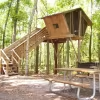
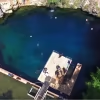
Thanks to dedicated volunteers and community support, the group has raised and invested funds to acquire 128 acres of land which includes 48 acres of upland and 80 acres of forested wetlands, constructed a boardwalk to the lake that is 2,856 feet long, a dock and classroom-sized pavilion on the lakefront and a second pavilion on the West Orange Trail. Interpretive trails through the uplands help visitors recognize the species there, and walking tours are routinely held for school groups as well as recreation groups. With many man hours from volunteers, development of ONP proceeded. The group built an education center, patterned after a pioneer homestead log building that includes a classroom, a museum, office and bathrooms. This building has become an environmental education center with a main theme based on restoration ecology.
In earlier eras, Florida residents found easy access to the lake, as over two dozen fish camps lined its shores. But when the camps closed after the water quality and fishing declined, these semi-public lakefront access points disappeared. To increase access, communities around the lake have joined together with the Friends of Lake Apopka and the Green Mountain Scenic Byway to create a paved, 52-mile, multi-use recreation trail to encircle the lake. Once completed, this Lake Apopka Loop Trail will offer visitors the ability to see the lake’s alligators and water birds.
The loop will link up with existing trails that lead to Clermont, Tavares and Orlando. Those nearby trails include the Lake Minneola Scenic Trail, which provides views and access to Lake Minneola and Plum Lake. Winter Garden, with its restored downtown and rail-trails, offers lake access via a municipal park.
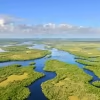
The largest success story of Lake Apopka’s restoration is the 19,000-acre Lake Apopka Restoration Area. Run by the St. Johns River Water Management District, the area includes farms acquired by the state to help bring the water quality back. The process was not without setbacks, but the result is an ambitious system that filters some of Lake Apopka’s waters by circulating it through restored wetlands.
Watching the water percolate isn’t the only activity offered on the property. Hiking, off-road cycling and horseback riding also are permitted in the Clay Island and Duda portions of the district’s restoration area. The loop is 5.8 miles long, and it includes an observation tower. The North Shore trail includes marshes in a roughly four-mile walk to the lakeside. Plans are underway to open a trail across the entire Lake Apopka Restoration Area by the end of 2012.
The transformation of these farmlands into functioning wetlands has helped improve water quality. While the water is not as clean as it was 100 years ago, the clarity is improving, allowing natural water grass to grow again in areas where it has not been seen since World War II.
The returning vegetation not only helps filter the lake water, but it has also attracted rare and endangered birds – 346 species, to be exact, more even than can be found in the Everglades. But visitors will see more than birds. Bobcat and river otters have also returned to the lake’s edge, an edge that came very close to being filled with rubble just a few decades ago.
And the fish camps are coming back too. At least one of them. Thomas’ group found an old camp building in Mount Dora that will be restored for the Oakland Preserve. “We got him to give us one of the board-and-batten cypress-lumber cabins,” says Thomas.


